

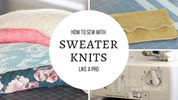
Tips for Sewing Sweater Knits
, by Holly Hetzner, 13 min reading time
, by Holly Hetzner, 13 min reading time
Sewing with sweater knits can be a little daunting if you haven’t much experience with them. Unlike other knits, they tend to do what they want, when they want to, and sometimes that doesn’t bode well when your aim is to cut and sew them up into a structured garment. Many of our patterns look great with a sweater knit, and we wanted to make sure to give you all some words of advice before you start! Hopefully these tips and tricks will alleviate any frustration you may encounter as a beginner.

Let’s begin by identifying different types and attributes of sweater knits. Some are actually pretty darn easy to sew with and knowing what you’re dealing with is half of the battle. Sweater knits come in a variety of types, fibers, weaves, stretch orientations, weights and laundering requirements. When purchasing these online, it’s not always explicitly written what you will be getting and so much of the time sweater knits are sold in bundles with a bunch types combined. Don’t be afraid of these. Once you’ve got the right tools and a little bit of know-how, you will have it down in no time!
Here is a list of common types of sweater knits found in the retail market:
Below are the descriptions you should be either looking for or measuring before beginning your project. Pairing the stretch, weave and weight of a fabric to the pattern you want to sew up with is key. Always ask yourself, will this fabric behave appropriately with the pattern you have chosen? If the pattern is intended to drape and slouch, a sweater knit with a high stretch and low recovery will work well. If the pattern is intended for a more structured knit, you’ll want to pick out a fabric with good recovery and potentially less stretch. Always read over a pattern to determine if the designer has laid out the best fabrics or stretch requirements for you to use. This will save you time and frustration.

Now that we know what we are working with, let’s get our machine settings set up. This article is going to share with you the settings that work on OUR machines. It’s important to know that every machine is different (even within the same brand/model) and your machine most likely will need slightly different settings. That said, these should be a decent starting point for you to work away from. Sewing sweater knit without taking the time to adjust your machine settings usually results in wavy seams (as pictured). The fabric gets stretched and pulled instead of gently feeding through a stitch. On that same note, make sure that you are simply supporting the fabric as it feeds through the machine; do not pull the fabrics as they feed through or you will get waving simply due to that.

But before we dig in too deep, be sure that you have washed and dried your sweater knit prior to cutting out your project. Sweater knits especially can shrink a fair amount. Hence why we have all had that super cute sweater knit top we just bought from the department store tossed into the donate pile after the first wash. On that note, be sure to take a look at the recommended care instructions for the fabric you are using. Many that say they are dry clean only, CAN be washed at home either by hand or in cold water and hung to dry.
My preferred way to construct garments using sweater knit is to use a serger. This is for a couple of reasons. The first reason being that the serger seals the raw edges of the fabric as you sew. This means no fraying, no stitching over the project twice. If you sew a fair amount of your own clothes, a serger is definitely recommended. The second reason I prefer a serger to a sewing machine when constructing garments from sweater knit is the feed dogs on a serger seam to glide fabric through the stitch with much more fluidity. That said, a traditional sewing machine can do the trick to. Now, let’s talk about setting up your serger to sew sweater knit.
Pictured here are the settings that we use over at DIBY for our Brother 1034D Serger. These settings likely will not be the same settings that your machine will use. But this is a starting point to work off of. Grab yourself a scrap of fabric and let’s begin. The goal here is to achieve a nice flat seam, to eliminate any waviness that would occur from improper settings or manual pulling. When sewing with sweater knit, it’s very easy to develop these dreaded wavy seams. Don’t let this frighten you off! It’s pretty straight forward and after a couple of times adjusting it, you’ll know what settings you need for the next time.
When sewing with sweater knits you want to loosen up everything. This is so that the fabric, bulky or thin can glide through the stitch without getting stretched out by the presser foot, feed dogs or thread tensions. Sweater knits can be VERY stretchy and this makes them susceptible to stretching under the machine. Go down the line and make these setting adjustments to your machine.
Test out settings on your scrap of fabric. Fold your scrap in half so that you have two layers to stitch though and feed the edge through the machine. If it's too loose of a stitch, tighten up the looper. If the presser foot isn’t allowing the fabric to feed through the machine as quickly as it’s stitching then adjust the differential feed. If the stitches are too close together and stretching the fabric, adjust the stitch length. This is all a test process and only takes 2 or 3 minutes to get perfected.

Using a traditional sewing machine to construct sweater knit garments can be slightly more difficult but is absolutely achievable. Grab your scrap of fabric, fold it in half and then adjust these settings on your machine at home. Again, these settings are what works on OUR machine and your machine will be different. Use these at a starting point and make the appropriate adjustments as needed on a scrap.

Another point of potential frustration is when it comes to topstitching or hemming on sweater knit. For a sewing machine, use the same settings that you had set up for construction and carry on with a simple straight stitch. Some people prefer to use fusible hem tape or other additives to achieve a crisp hemline. Personally, it’s not recommended by us because you want to retain the natural drape of the fabric. The easiest way to hem sweater knit is to choose a banded option on a pattern or to double fold the hemline and stitch in place using a long straight stitch or a stretch stitch. Give it a good steam at the end (being sure to use the appropriate heat setting for the fiber content of the fabric).
Topstitching on a coverstitch machine is a breeze in comparison. If you haven’t added one of these babies to your wish list already, be sure to add one now. Topstitching and hemming with a coverstitch machine allows you to achieve a stretchy finish while at the same time finishing the raw edges of your fabric with the looper side of the stitch. If you do have a coverstitch machine, start by using these settings pictured here and making small adjustments until your scrap fabric comes out just right.

Using stretchy sweater knit leaves the seams open to stretching or growing throughout the day. To prevent the neckline or shoulders from growing on you, layer some 1/4″ clear elastic in those seams during construction. Easy peasy!
There is one last thing that I want to note. If you went through all the steps and you STILL have minor waviness going on, DO NOT STRESS. Typically a steaming iron or a wear and wash cycle or two will resolve this and the seams will settle into being flat. So go forth, buy all the sweater knits this season!
Want to try out a knit sweater pattern? Try the Adrianne Open Side Slouchy Sweater!
-- Originally written by Kelly Bailey. Archived by Holly Hetzner.